Apotheosis Of Saint Mark
St. Mark's English Church
Florence, Italy
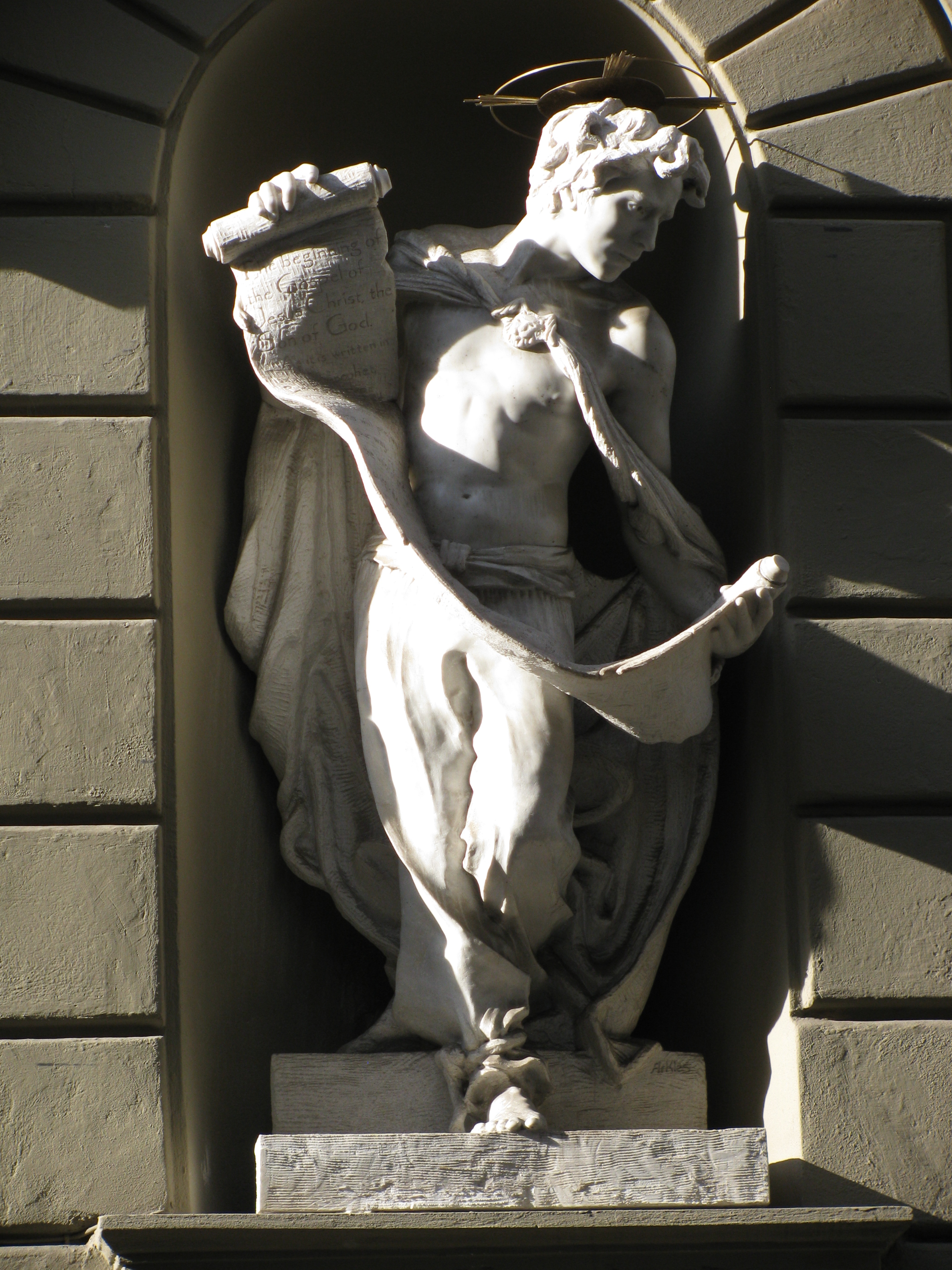
This life-size marble figure was carved for the Anglican Church in Florence in 2007-2008. It sits in its niche directly above the main doors of the church, visible for hundreds of feet up and down Via Maggio, one of the main streets in Florence. This highly prestigious commission came to completion as a result of the generosity of St. Mark's church and many of its members, clergy and staff, as well as my own friends and associates in Florence. Although I was the right person at the right place at the right time, it wouldn't have been possible without their help and support.
This sculpture makes me the only American sculptor, living or dead, to have a permanent, large-scale public monument in Florence. Interestingly, I first noticed this conspicuously empty niche in the center of Florence ten years ago, and even made a study for a St. Mark statue for this niche as a student. When I discovered late in 2006 that the church was about to undergo extensive restoration, I decided to show my portfolio to Father Lawrence Maclean, chaplain of the church; one thing led to another...Dreams can come true.
The statue of St. Mark is an apotheosis; it is symbolic of the salient points of the life of the saint, rather than a depiction of the saint at a certain time or place .He is represented as a young man, bare-chested and with his cloak slipping off his shoulders. This refers to the verse in the Gospel of St. Mark which describes how a young man was present in the Garden of Gethsemane with Christ and how this lad was nearly hauled off by the Roman guards, but escaped by wriggling out of the cloak he was wearing and running off into the night. Traditionally, this verse has been interpreted as a description of Mark himself, present at the scene.

Ropes bind his ankle and wrists. This refers to the manner in which Mark was eventually martyred, dragged to death in the streets of Alexandria, Egypt, where Mark served as the first Bishop of Alexandria. The vaguely North African style of the trousers he wears also alludes to this time. The scroll, incised with the first verses of the Gospel of St. Mark, obviously reflects the role of evangelist. Finally, the brooch holding the cloak together across mark's chest is a simple winged lion design, the iconographic representation of St. Mark used often throughout the history of religious art.
Lady Chapel Altar
St. Mark's Church
Florence, Italy
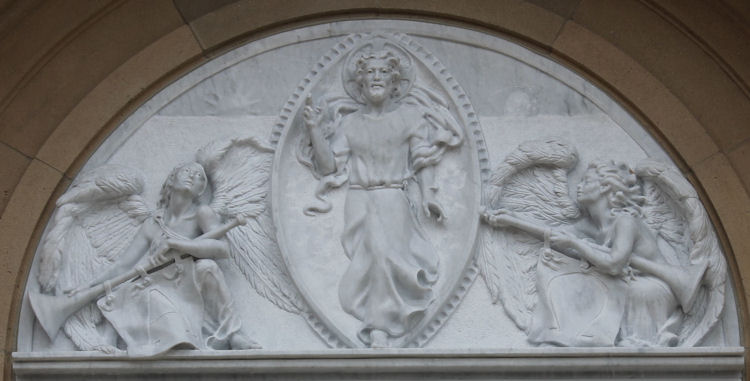
At the same time I received the commission for the St. Mark statue I was also tasked with the construction of a new altar for the Lady Chapel of the same church. I chose to carve the altar out of Rosso Verona marble, a mottled red and orange stone. It's known as an 'antique' marble - that is, the quarry from which the stone is taken has been open for centuries, and has been thoroughly mined. Mostly, stone from this quarry nowadays is either fairly small or of secondary quality. It took over a month to locate stone of high quality and of sufficient size for the altar, but the search was worthwhile, as Rosso Verona has a jewellike quality which was at the heart of the design concept.

The design for the altar base is based loosely on two floor standing candlesticks in the church, located on either side of the icon behind the pulpit. Because of the small size of the Lady Chapel, I was careful not to create a design that would dominate this space, hence the single pedestal leg rather than two or four legs. Incorporated into the base are lion's paws, a subtle tribute to the patron saint of the church, and three Fleur de lis in the Florentine style with an 'M' superimposed upon them, for Mary. Inlaid into the top of the altar are five crosses in Carrara Statuario marble, the highest quality white marble in Italy.
Atop the base of the pedestal is a column capital, wich I carved by hand rather than turning it on a lathe. Around the rim of this is the inscription of dedication to Bruce Sherman Noll, father of Candice Noll, whose patronage made the altar possible.
King Monument
Mt. Gilead Church, Pittsboro, North Carolina
This funerary monument was completed in February 2006, after eight month's work. The design is based on the tomb of Emelyn Story, wife of William Wetmore Story, an American sculptor living in Rome in the 19th Century.
Story's tomb and its Angel of Sorrow has proved a popular motif for monument builders and those who would commission them. Several similar works can be found in the United States, including New Orleans and Stanford University. But rather than copy Story's work, I hired a model and put her into a pose similar (but not identical) to the original pose. The biggest deviations I made were in the style of modeling and dress, and in the choice of materials.
I'm not a Neoclassicist (I'm a Naturalist), and so the figure was not given a Greek nose or any of the classicizing elements common in Story's day. Along with the naturalistic modeling, I chose to dress the model in a strapless evening gown, rather than a bedsheet toga. It's funny - artists have traditionally used the toga to denote timelessness regarding their subject. Putting a toga on a figure these days is about the most dated thing you can do, short of a poodle skirt. Evening gowns seem to have that timeless quality an angel needs - we'll see if posterity agrees.
What seems to please me the most is the contrast between marble and bronze in the work. It's something I've wanted to try ever since I saw an exhibition of Louis-Phillippe Hebert's work in Quebec. His monuments are fantastic, integrating figurative bronze with stone architecture in a way that goes far beyond the traditional figure/pedestal relationship. Every rendition I've come across of Story's tomb have been entirely of marble, and yet the several components of the monument (figure, bouquet, dais, tombstone) were perfectly suited for Hebert's idea of rendering static, inorganic architecture in stone and organic, fleshy elements in bronze. Also - and this was not insignificant - it's more cost effective and less laborious to render figures in bronze than in marble, and at the same time less laborious and almost as inexpensive to render architecture in marble, rather than bronze.
This is my first large scale monument, and I must thank Dr. Jerry King for the opportunity to finally show what I can do. I also need to give credit where it's due - The choice of basing the work upon Story's tomb was entirely his, as is the unique inscription and the excellent siting of the piece, and without the honest criticism of a knowledgeable art lover such as Jerry, this monument would have been good enough, instead of good.
One Single Step
Wilmington Riverwalk, Wilmington, North Carolina
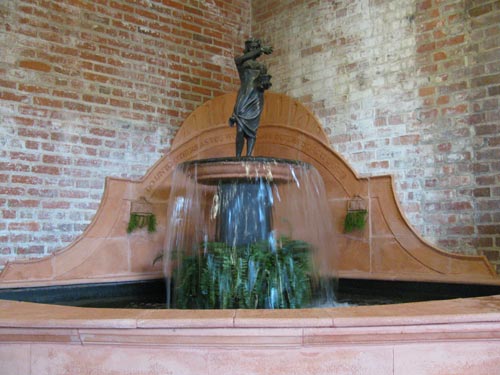
The title of the piece is derived from the expression, A journey of a thousand miles begins with a single step. Whether the figure in the sculpture has just arrived or is about to leave is intentionally ambiguous, giving leave for each viewer to ultimately determine the motive behind the work as he or she sees fit. Is she windblown and a little cold, or does she stand with a pose of determined resolve? A goal of this work and its proximity to the water is to draw to the viewer's attention the dual nature of a port as both a safe haven in rough weather and as a doorway to the world.
One Single Step is cast in a lightweight resin from the original clay model. This resin cast is not for sale, although editions in bronze are available.